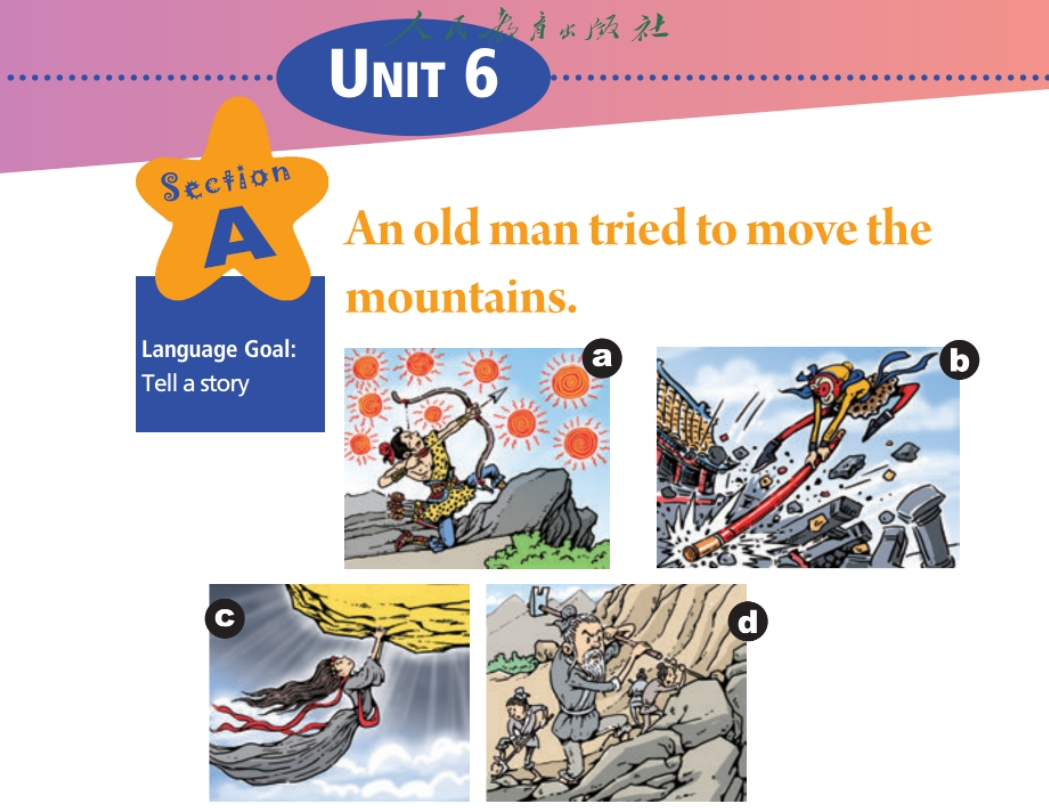


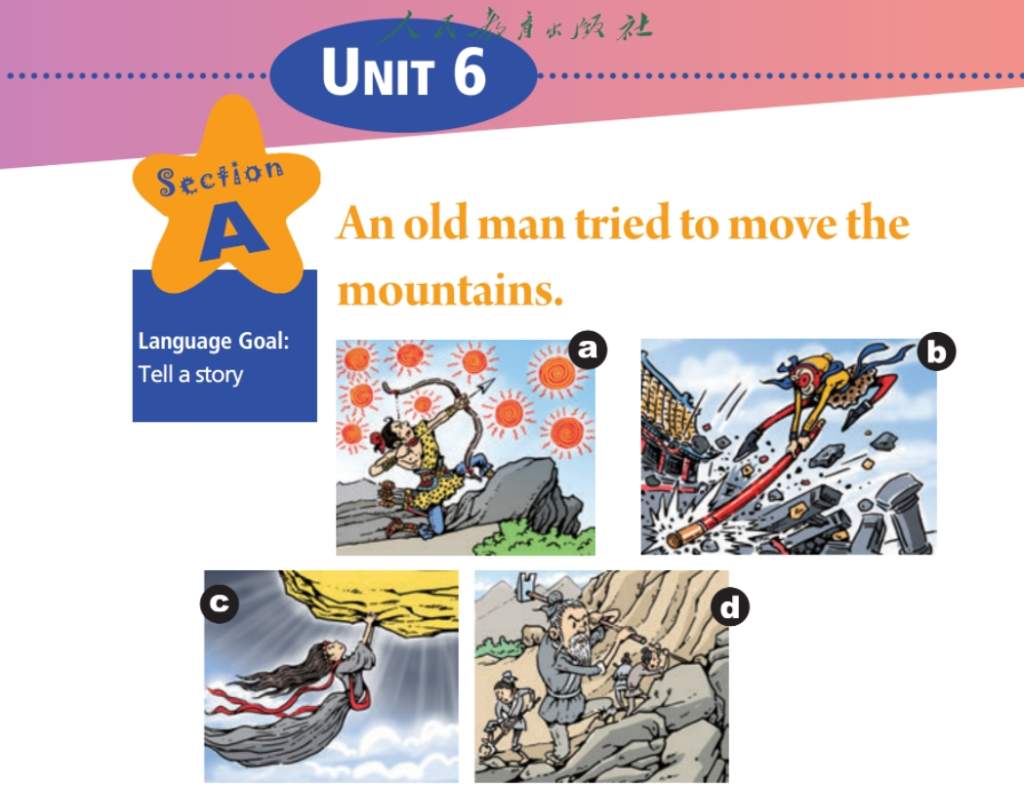
Unit 6 And old man tried to move the mountains.
Section A
1b Listen and check(√)the facts you hear. Which story are Anna and Wang Ming talking about?
听录音,将你听到的事实打“√”。安娜和王明正在谈论哪个故事?
Wang Ming:Hi, Anna.
王明:嗨,安娜。
In my Chinese class today, we read a famous story called Yu Gong Moves a Mountain.
今天在我的中文课上,我们读了一个叫做《愚公移山》的著名故事。
Anna:Oh, how does the story begin?
安娜:噢,这个故事是怎样开始的?
Wang Ming:Well, once upon a time, there was a very old man.
王明:哦,从前,有一个老人。
There were two mountains near his house.
在他家附近有两座山。
They were so high and big that it took a long time to walk to the other side.
它们如此高大以至于走到另一边要花很长时间。
Anna:So what happened next?
安娜:那么接下来发生了什么?
Wang Ming:Well, the old man told his family that they should all help him to move the mountains.
王明:哦,这个老人告诉他的家人他们都应该帮助他移山。
Anna:Mm, but an old man probably couldn’t even move a small tree.
安娜:嗯,但是一个老人可能甚至不能移动一棵小树。
Wang Ming:Yes, that’s what his wife said, too.
王明:是的,那也是他的妻子说的。
Anna:And where would they put all the earth and stone from the mountains?
安娜:他们将把山上所有的土和石头放到哪里?
Wang Ming:Yu Gong said they could put it into the sea because it’s big enough to hold everything.
王明:愚公说他们可以把它放到海里,因为海足够大能够容纳一切东西。
So they all started digging the next day.
因此第二天他们就都开始挖山了。
2a Listen and number the pictures [1-4] in order to tell the story.
听录音。把图画标上数字[1~4]以便于讲故事。
Wang Ming:Let me tell you the rest of the story about Yu Gong.
王明:让我告诉你关于愚公的剩余的故事。
Yu Gong and his family began to move some of the earth and stone to the sea.
愚公和他的家人开始把一些土和石头移到海里去。
One day, a man saw Yu Gong and his children when they were working on moving the mountains.
一天,一个人看见了愚公和他的孩子们在忙着移山。
He told Yu Gong that he could never do it because he was old and weak.
他告诉愚公他绝不可能做到,因为他年老体弱。
As soon as the man finished talking, Yu Gong said that his family could continue to move the mountains after he died.
这个人一说完,愚公就说他死后他的家人将继续移山。
His family would live and grow, but the mountains could not get bigger.
他的家人将会继续生存并且繁衍壮大,但是山不可能变得更大。
So Yu Gong and his family kept on digging day after day and year after year.
因此愚公和他的家人日复一日,年复一年地坚持挖山。
Finally, a god was so moved by Yu Gong that he sent two gods to take the mountains away.
最后,天帝被愚公感动了,于是派了两个神仙移走了大山。
This story reminds us that you can never know what’s possible unless you try to make it happen.
这个故事提醒我们,你永远不知道什么是可能的,除非你努力让它发生。
2b Listen again and circle the words you hear.
再听一遍录音。圈出你所听到的单词。
Wang Ming:Let me tell you the rest of the story about Yu Gong.
王明:让我告诉你关于愚公的剩余的故事。
Yu Gong and his family began to move some of the earth and stone to the sea.
愚公和他的家人开始把一些土和石头移到海里去。
One day, a man saw Yu Gong and his children when they were working on moving the mountains.
一天,一个人看见了愚公和他的孩子们在忙着移山。
He told Yu Gong that he could never do it because he was old and weak.
他告诉愚公他绝不可能做到,因为他年老体弱。
As soon as the man finished talking, Yu Gong said that his family could continue to move the mountains after he died.
这个人一说完,愚公就说他死后他的家人将继续移山。
His family would live and grow, but the mountains could not get bigger.
他的家人将会继续生存并且繁衍壮大,但是山不可能变得更大。
So Yu Gong and his family kept on digging day after day and year after year.
因此愚公和他的家人日复一日,年复一年地坚持挖山。
Finally, a god was so moved by Yu Gong that he sent two gods to take the mountains away.
最后,天帝被愚公感动了,于是派了两个神仙移走了大山。
This story reminds us that you can never know what’s possible unless you try to make it happen.
这个故事提醒我们,你永远不知道什么是可能的,除非你努力让它发生。
Section A, Activity 2D
Role-play the conversation.
角色扮演对话。
So, what do you think about the story of Yu Gong?
你对愚公移山的故事有何看法?
I think it’s really interesting.
我觉得这个故事很有趣。
Yu Gong found a good way to solve his problem.
愚公找到了解决问题的好方法。
Really? I think it’s a little bit silly.
真的吗?我倒觉得有点傻。
It doesn’t seem possible to move a mountain.
移山看起来不太可能实现。
But the story is trying to show us that anything is possible if you work hard.
但这个故事想告诉我们:只要努力,万事皆有可能。
Yu Gong kept trying and didn’t give up.
愚公坚持不懈,从未放弃。
Well, I still don’t agree with you.
嗯,我还是不同意你的观点。
I think we should try to find other ways to solve a problem.
我认为应该尝试寻找其他解决问题的方法。
But what could Yu Gong do instead of moving the mountains?
但愚公除了移山,还能做什么呢?
Well, there are many other ways.
其实还有很多其他方法。
For example, he could build a road.
比如他可以修一条路,
That would be better and faster than moving a mountain.
这比移山更快捷有效。
You have different opinions about the story, and neither of you is wrong.
你们对这个故事有不同见解,但都没有错。
There are many sides to a story and many ways to understand it.
一个故事有多重角度,理解方式也各不相同。
Section A Activity 3A
Read the passage and answer the questions.
阅读短文并回答问题。
In November 1979, pupils in England were able to watch a new TV program called Monkey.
1979年11月,英国学生能够观看一个名为《美猴王》的新电视节目。
Most of them were hearing this story for the first time.
他们中的大多数是第一次听到这个故事。
However, this story is not new to Chinese children.
然而,这个故事对中国孩子来说并不新鲜。
The Monkey King or Sun Wukong is the main character in the traditional Chinese book Journey to the West.
美猴王孙悟空是中国传统书籍《西游记》中的主角。
The Monkey King is not just any normal monkey.
美猴王不是普通的猴子。
In fact, he sometimes does not even look like a monkey.
事实上,他有时甚至看起来都不像只猴子。
This is because he can make 72 changes to his shape and size, turning himself into different animals and objects.
这是因为他能进行72变,把自己变成不同的动物和物体。
But unless he can hide his tail, he cannot turn himself into a person.
但除非他能把尾巴藏起来,否则无法把自己变成人。
To fight bad people, the Monkey King uses a magic stick.
为了对抗坏人,孙悟空使用金箍棒。
Sometimes he can make the stick so small that he can keep it in his ear.
有时候他能把金箍棒变得很小,可以放在耳朵里。
At other times, he is able to make it big and long.
在其他时候,他能够使它又大又长。
The Monkey King has excited the children of China for many years.
多年来,孙悟空一直让中国的孩子们兴奋不已。
And as soon as the TV program came out more than 30 years ago, Western children became interested in reading this story.
30多年前这个电视节目一播出,西方孩子就对这个故事产生了兴趣。
Because the clever Monkey King keeps fighting to help the weak and never gives up.
因为聪明的孙悟空不断战斗帮助弱者,永不放弃。
Section B
1b Listen and number the pictures [1-5] in 1c.
听录音,把1c里的图片标上数字[1~5]。
Mei Ling:Tom, can you tell me a story from Europe?
梅玲:汤姆,你能给我讲一个来自欧洲的故事吗?
Tom:Well, I know one. It’s called The Emperor’s New Clothes.
汤姆:好的,我知道一个。它名叫《皇帝的新装》。
This story is about an emperor who loved clothes.
这个故事是关于一个特别喜欢衣服的皇帝。
He loved buying and looking at his beautiful clothes.
他喜欢买并且看他的漂亮衣服。
Mei Ling:So what happened?
梅玲:那么发生了什么?
Tom:Two brothers came to the city to make special clothes for the emperor.
汤姆:两个兄弟来到这座城市为皇帝制作特别的衣服。
But the emperor had to give them silk and gold.
但是皇帝得给他们丝绸和黄金。
Mei Ling:Were the clothes nice?
梅玲:衣服好看吗?
Tom:Well, the brothers kept everything for themselves.
汤姆:噢,这两个兄弟将所有的丝绸和黄金据为己有。
And told the emperor that people couldn’t see the clothes unless they were clever.
并且告诉皇帝不聪明的人是看不到这些衣服的。
Mei Ling:Oh, so they were really trying to cheat the emperor!
梅玲:哦,那么他们的确在试图欺骗皇帝!
Tom:Yes, you are right.
汤姆:是的,你说得对。
When the emperor looked at himself, he only saw his underwear.
当皇帝看自己时,他只看到了他的衬衣。
But he didn’t want people to think he was stupid.
但是他不想让人们认为他是愚蠢的。
So he said his new clothes were very beautiful.
因此他说他的新衣服非常漂亮。
Mei Ling:Did he wear the new clothes?
梅玲:他穿新衣服了吗?
Tom:Yes, he did.
汤姆:是的,他穿了。
He walked through the city wearing his new clothes.
他穿着他的新衣服巡游城市。
Nobody wanted to sound stupid.
没人想让自己听起来愚蠢。
So everyone said his new clothes were wonderful.
因此每个人都说他的新衣服好看极了。
But suddenly, a young boy shouted, “Look! The emperor isn’t wearing any clothes!”
但是突然,一个小男孩大喊:“看!皇帝没有穿任何衣服!”
Mei Ling:What a funny story!
梅玲:这故事真有趣!
1c Listen again and fill in the blanks.
再听一遍录音,填空。
Mei Ling:Tom, can you tell me a story from Europe?
梅玲:汤姆,你能给我讲一个来自欧洲的故事吗?
Tom:Well, I know one.
汤姆:好的,我知道一个。
It’s called The Emperor’s New Clothes.
它名叫《皇帝的新装》。
This story is about an emperor who loved clothes.
这个故事是关于一个特别喜欢衣服的皇帝。
He loved buying and looking at his beautiful clothes.
他喜欢买并且看他的漂亮衣服。
Mei Ling:So what happened?
梅玲:那么发生了什么?
Tom:Two brothers came to the city to make special clothes for the emperor.
汤姆:两个兄弟来到这座城市为皇帝制作特别的衣服。
But the emperor had to give them silk and gold.
但是皇帝得给他们丝绸和黄金。
Mei Ling:Were the clothes nice?
梅玲:衣服好看吗?
Tom:Well, the brothers kept everything for themselves.
汤姆:噢,这两个兄弟将所有的丝绸和黄金据为己有。
And told the emperor that people couldn’t see the clothes unless they were clever.
并且告诉皇帝不聪明的人是看不到这些衣服的。
Mei Ling:Oh, so they were really trying to cheat the emperor!
梅玲:哦,那么他们的确在试图欺骗皇帝!
Tom:Yes, you are right.
汤姆:是的,你说得对。
When the emperor looked at himself, he only saw his underwear.
当皇帝看自己时,他只看到了他的衬衣。
But he didn’t want people to think he was stupid.
但是他不想让人们认为他是愚蠢的。
So he said his new clothes were very beautiful.
因此他说他的新衣服非常漂亮。
Mei Ling:Did he wear the new clothes?
梅玲:他穿新衣服了吗?
Tom:Yes, he did.
汤姆:是的,他穿了。
He walked through the city wearing his new clothes.
他穿着他的新衣服巡游城市。
Nobody wanted to sound stupid.
没人想让自己听起来愚蠢。
So everyone said his new clothes were wonderful.
因此每个人都说他的新衣服好看极了。
But suddenly, a young boy shouted, “Look! The emperor isn’t wearing any clothes!”
但是突然,一个小男孩大喊:“看!皇帝没有穿任何衣服!”
Mei Ling:What a funny story!
梅玲:这故事真有趣!
Section B Activity 2B
Read the passage and answer the questions.
阅读短文并回答问题。
Do you remember what you were doing?
你还记得你在做什么吗?
People often remember what they were doing when they heard the news of important events in history.
人们经常记得当他们听到历史上的重要事件时自己在做什么。
In America, for example, many people remember what they were doing on April 4, 1968. This was an important event in American history.
例如在美国,许多人记得1968年4月4日他们在做什么。这是美国历史上的一件大事。
On this day, Dr. Martin Luther King was killed.
就在这一天,马丁·路德·金博士被杀害了。
Although some people may not remember who killed him, they remember what they were doing when they heard the news.
虽然有些人可能不记得是谁杀了他,但他们记得听到这个消息时自己在做什么。
Robert Allen is now over 50 but he was a school pupil at that time.
罗伯特·艾伦现在已经50多岁了,但那时他还是个小学生。
“I was at home with my parents,” Robert remembers.
“我和父母在家,”罗伯特回忆道。
“We were eating dinner in the kitchen when we heard the news on the radio.
“我们在厨房吃晚饭时,听到收音机里的消息。
The news reporter said: ‘Dr. King died just 10 minutes ago.’
新闻记者说:’金博士十分钟前刚去世。’
My parents were completely shocked.
我父母完全震惊了。
My parents did not talk after that, and we finished the rest of our dinner in silence.”
此后我父母没有说话,我们默默地吃完了剩下的晚餐。”
More recently, most Americans remember what they were doing when the World Trade Center in New York was taken down by terrorists.
最近,大多数美国人都记得当纽约的世贸中心被恐怖分子袭击时自己在做什么。
Even the date—September 11—2001 has meaning to most Americans.
即使是2001年9月11日这个日期对大多数美国人来说意义重大。
This was a day Kate Smith will never forget.
这是凯特·史密斯永远不会忘记的一天。
She remembers working in her office near the two towers.
她记得自己当时在双子塔附近的办公室工作。
“My friend shouted that a plane just hit the World Trade Center!
“我朋友大喊一架飞机刚刚撞上了世界贸易中心!
didn’t believe him at first, but then I looked out the window and realized that it was true.
起初我不相信他,但后来我望向窗外,意识到这是真的。
was so scared that I could hardly think clearly after that.”
我害怕得几乎无法思考,显然在那之后。”
八年级下册 Unit 6单词
- shoot [ʃu:t] v.(shot)投篮,射击,发射
- stone [ˈstəʊn] n. 石头
- weak [wi:k] adj. 虚弱的,柔弱的
- god [ɡɒd] n. 上帝,神
- remind [rɪˈmaɪnd] v. 提醒,使想起
- bit [bɪt] n. 一点,小块
- a little bit 有点儿,稍微
- silly [ˈsɪlɪ] adj.愚昧的;傻子,蠢货
- instead of 代替,反而
- turn into 变成
- object [ˈɒbdʒɪkt] n. 物体,目标,物品
- hide [haɪd] v. 躲藏,隐藏
- tail [teil] n. 尾巴
- magic [ˈmædʒɪk] n. 魔法,巫术
- stick [stɪk] n. & v.棍,棒;刺,戳,插
- excite [ɪk’saɪt] v. 使激动,使兴奋
- Western [‘westən] adj. 西方的,欧美的
- once upon a time 从前
- stepsister [ˈstepsɪstə(r)] n. 继姐(妹)
- prince [prɪns] n. 王子
- fall in love 爱上,喜欢上
- fit [fɪt] v. 适合,合身
- couple [‘kʌpl] n. (尤指)夫妻,两人
- smile [smaɪl] n.& v. 微笑
- marry [ˈmæri] v. 与某人结婚
- get married 结婚
- gold [ɡəʊld] n. 黄金,金币
- emperor [ˈempərə(r)] n. 皇帝
- silk [sɪlk] n. 丝绸
- underwear [ˈʌndəwɛə] n. 内衣
- nobody [ˈnəʊbədi] pron. 无人,没有任何人,谁也不
- stupid [‘stju:pɪd] adj. & n. 愚蠢的,傻的;傻子
- cheat [tʃi:t] v. 欺骗,愚弄
- stepmother [ˈstepmʌðə(r)] n. 继母
- wife [waɪf] n. 妻子
- husband [ˈhʌzbənd] n. 丈夫
- whole [həul] adj. 全部的,整体的
- scene [si:n] n. 舞台,(戏剧)场景
- moonlight [‘mu:nlaɪt] n. 月光
- shine [ʃaɪn] v. 照耀,发光
- bright [braɪt] adj. &adv. 明亮的,发亮的;明亮地
- ground [graʊnd] n. 地面
- lead [li:d] n.& v. 领导,主角;带路
- voice [vɔis] n. 嗓音
- brave [breiv] adj. 勇敢的
- Claudia 克劳迪亚(女名)
- Journey to eh west《 西游记》
- the Monket King 美猴王
- Sleeping beauty 《睡美人》
- Cinderella 《灰姑娘》
- Little Red Riding Hood 《小红帽》
- Hansel annd Gretel 《韩塞尔与葛雷特》(《糖果屋》)







暂无评论内容